The same experience can help an agent differently when presented
as text or an image. SwitchMem learns to select
the memory modality that fits each interaction step, giving a
frozen GUI agent the right representation of its past experience.
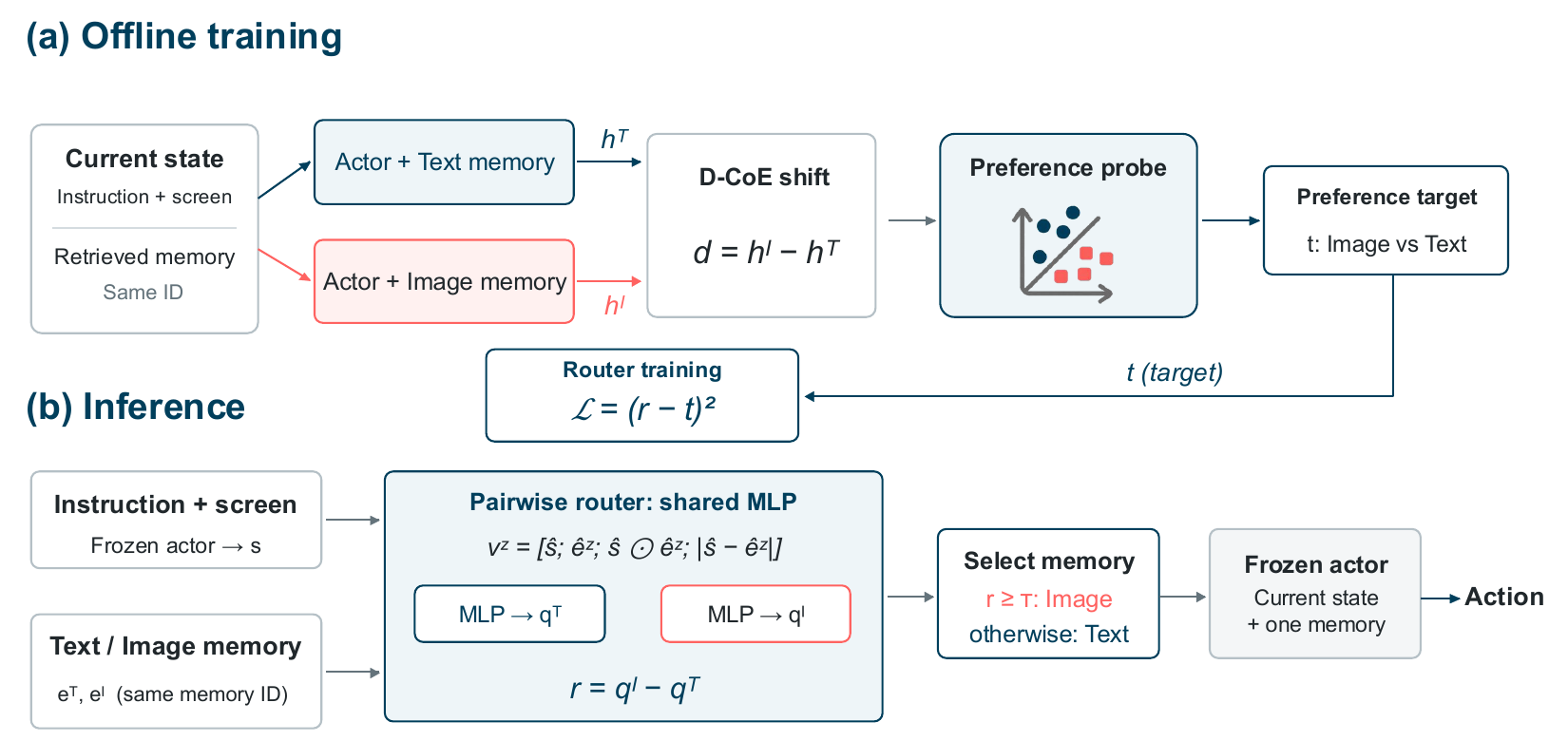
Learn a preference signal offline. Select one memory modality at each step. Figure 5 in the paper.
Problem
One memory modality cannot fit every step.
GUI agents reuse demonstrations to navigate unfamiliar interfaces
and avoid repeated errors. Most memory systems commit to a fixed
representation: text, screenshots, or both together.
Text offers a compact semantic abstraction, while images preserve
layout and appearance. Their usefulness changes with the current
interface and the action the agent needs to take. SwitchMem treats
this choice as part of the interaction loop.
Motivating Observation
Neither text nor images consistently dominate.
With the retrieved demonstration held fixed, Text and Image each
win on substantial subsets of interaction steps. A step-wise
oracle reveals the headroom left by a fixed memory policy.
A nearly even split
Share of non-tied steps by preferred modality.
AITW
48.0%52.0%
LearnGUI
47.7%52.3%
Text memory Image memory
Figure 2 in the paper.
The cost of a fixed choice
Action score (%), best fixed modality → step-wise oracle.
AITW
49.3→55.9
LearnGUI
37.4→43.4
Figure 3 in the paper. The oracle uses ground-truth scores to choose between two generated actions; it is an analysis reference.
Method
From hidden-state shifts to a memory router.
SwitchMem uses the actor's internal response to memory modality
as supervision. A lightweight pairwise router then predicts
this preference from the current GUI state and the retrieved
memory candidates.
01 · Observe
Directional CoE
Run the frozen actor with Text and Image versions of the same
retrieved demonstration. Keep the signed hidden-state shift
hI − hT at the final prompt
token. Deeper layers expose a stronger modality-preference signal.
02 · Learn
Preference supervision
Standardize the final-layer shift, reduce it to 64 dimensions
with PCA, and fit a logistic probe on sampled action preferences.
Its continuous decision value becomes the target for training
a shared MLP scorer.
03 · Select
Step-wise routing
Score both memory candidates against the current-state
representation. Select Image when the score difference reaches
the calibrated threshold; otherwise select Text. Pass the
chosen memory to the frozen actor to generate its next action.
Routing Rule
r = qI − qTr ≥ τ: Image memory / otherwise: Text memory
The main experiments use a frozen Qwen3.5-9B actor and
Qwen3-VL-Embedding-2B for retrieval and memory embeddings. Both
candidates represent the same top-1 retrieved demonstration.
Main Results
Strongest performance across three GUI benchmarks.
SwitchMem improves over every fixed memory condition and the
evaluated memory-augmentation baselines with the same frozen
Qwen3.5-9B actor.
51.420%AITW action score
+2.120 points over Image
38.131%LearnGUI action score
+0.690 points over Image
63.043%MobileMiniWoB++ task success
+2.173 points over Both
Table 1 in the paper. All rows below use Qwen3.5-9B. Scores are percentages; higher is better.
Qwen3.5-9B performance on AITW, LearnGUI, and MobileMiniWoB++.
Method
AITW
LearnGUI
MobileMiniWoB++
No memory
41.920
23.485
58.696
RAG-GUI
18.300
24.186
9.783
M3A
17.200
20.899
41.304
AppAgent
14.780
31.104
25.000
Text memory
48.760
35.638
53.261
Image memory
49.300
37.441
57.609
Both modalities
47.080
26.919
60.870
EchoTrail
45.900
27.286
55.435
AGMem
45.380
28.366
52.174
SwitchMem (Ours)
51.420
38.131
63.043
AITW and LearnGUI use benchmark-specific step-level action scores.
MobileMiniWoB++ measures closed-loop task success (58/92 tasks).
Its router weights are transferred from LearnGUI; the threshold is
calibrated without actions, rewards, or task-success labels.
Routing Behavior
The choice changes within a trajectory.
SwitchMem frequently uses both modalities over the course of a
task, while retaining a chosen modality for consecutive steps.
Its policy adapts to interface state rather than assigning one
modality to the entire task.
Table 2 in the paper. Dual-modality trajectories use Text on some steps and Image on others.
Within-trajectory memory routing behavior.
Benchmark
Dual-modality trajectories (%)
Image-routed steps (%)
Mean switches per trajectory
Mean run length (steps)
AITW
83.8
36.5
1.72
2.42
LearnGUI
90.8
81.3
1.79
4.95
MobileMiniWoB++
57.8
76.3
1.56
4.50
Analysis
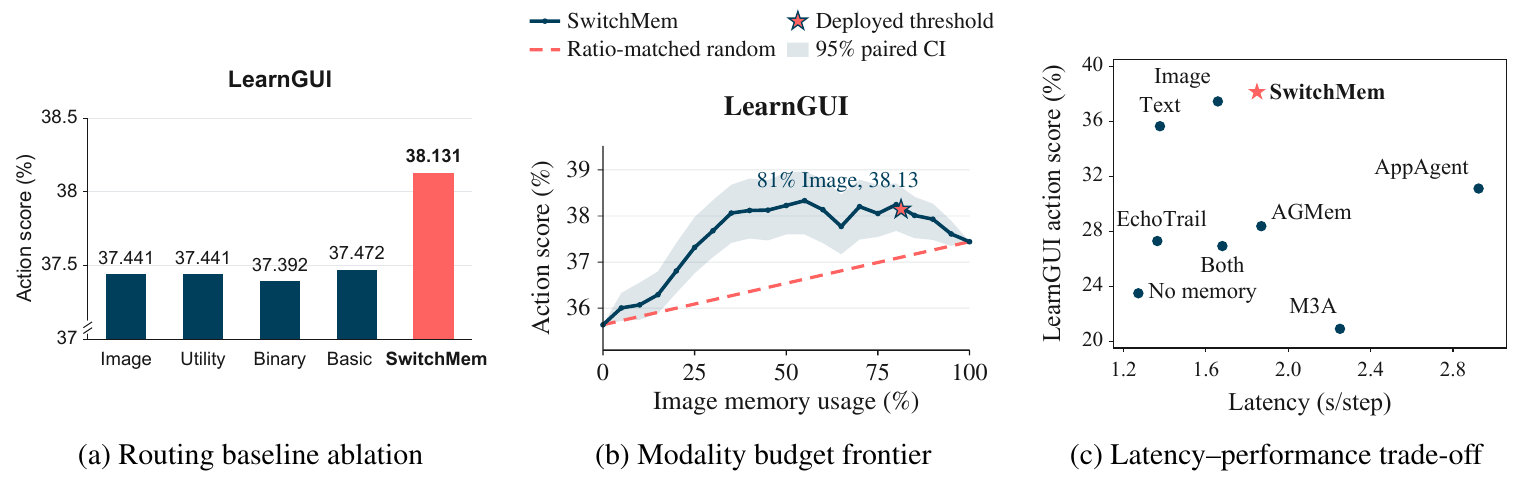
Useful routing depends on which step gets which memory.
Actor-derived preference supervision outperforms simpler routing
targets. SwitchMem also beats ratio-matched random selection at
every evaluated intermediate Image-use rate on LearnGUI: gains
come from assigning modalities to appropriate steps.
Routing supervision, modality budgets, and the latency–performance trade-off on LearnGUI. Figure 7 in the paper.
UI Density
Visually dense screens
Image memory becomes more useful when fine-grained layouts contain dense UI elements. SwitchMem increases Image selection in these states.
Action Context
Function-oriented actions
The Image-over-Text utility gap grows for actions governing interface functionality, task status, or system navigation.
Trajectory Progress
Evolving interfaces
Image memory becomes more useful after the initial state, as interface changes introduce visual details that textual abstraction may lose.
At inference, SwitchMem obtains a current-state hidden representation
for routing and then generates an action with the selected memory.
It avoids evaluating both memory-conditioned action prompts online.
The latency comparison uses the same RTX PRO 6000 GPU for all methods.
Generalization
The routing formulation works with a GUI-specialized actor.
Applying the preference-construction and routing protocol to
UI-TARS-7B-SFT also produces the best scores across all three
benchmarks, exceeding its strongest fixed memory condition.
Table 3 in the paper. UI-TARS-7B-SFT scores (%).
SwitchMem with the UI-TARS-7B-SFT actor.
Memory
AITW
LearnGUI
MobileMiniWoB++
No memory
29.980
25.705
23.913
Text
32.640
38.230
32.609
Image
30.440
40.997
33.696
SwitchMem (Ours)
33.680
41.055
36.957
Takeaway
How an agent remembers is part of how it acts.
Retrieving a relevant experience is only part of the problem.
Choosing its representation matters too. Memory modality
preference varies across steps and is reflected in the actor's
internal representations.
SwitchMem turns that signal into a practical routing policy,
combining the complementary strengths of text and image memory
while providing a single memory modality for each action.
Resources
Follow the project.
Learning How to Remember: Memory Modality Selection for GUI Agents Taeyun Roh, Suhyeong Park, Gijin Kim, Wonjune Jang, and Jaewoo Kang.